AI governance
Operationalize responsible AI with policies, approvals, and monitoring built into AiVRIC. Inspired by the transparency of the GitLab handbook and tailored to AI risk.
Principles
Accountability
Each model and integration has an owner, approver, and clear escalation path.
Explainability
Logs, prompts, and decisions are preserved to reconstruct how outcomes were produced.
Safety
Guardrails prevent data leakage, prompt abuse, and unsafe responses.
Lifecycle controls
- Intake: New AI use cases require business justification, data classification, and risk assessment.
- Evaluation: Run red-team tests for prompt injection, PII leakage, and bias before approval.
- Deployment: Enable guardrails, logging, and roll-back plans; pin model versions.
- Monitoring: Track drift, safety violations, and performance against expected outcomes.
- Review: Quarterly reviews of high-impact use cases with sign-offs.
- Retirement: Archive artifacts, revoke access, and clean up data stores.
Approvals & reviews
Two-person rule for production AI. Require approvers outside the implementing team for sensitive models or data.
Change proposals
Use tickets with templates: scope, risks, rollback, testing, owners.
Evidence
Attach test results, data lineage, and policy mappings to each change request.
Audit trail
AiVRIC logs who approved, when, and what changed for every guardrail and integration.
Guardrail library
| Category | Examples | Outcome |
|---|---|---|
| Safety | Prompt injection detection, jailbreak blocking, toxicity filters. | Reduces unsafe responses and abuse. |
| Privacy | PII redaction, data residency enforcement, data minimization checks. | Prevents sensitive data leakage. |
| Integrity | Model version pinning, approval gates, drift detection. | Ensures predictable, traceable outputs. |
| Compliance | Policy packs mapped to SOC 2, ISO 27001, and AI RMF controls. | Shows adherence to internal and external standards. |
Tip: Start with monitor mode for new guardrails, then enforce after review with the owning team. Capture deviations as exceptions with end dates.
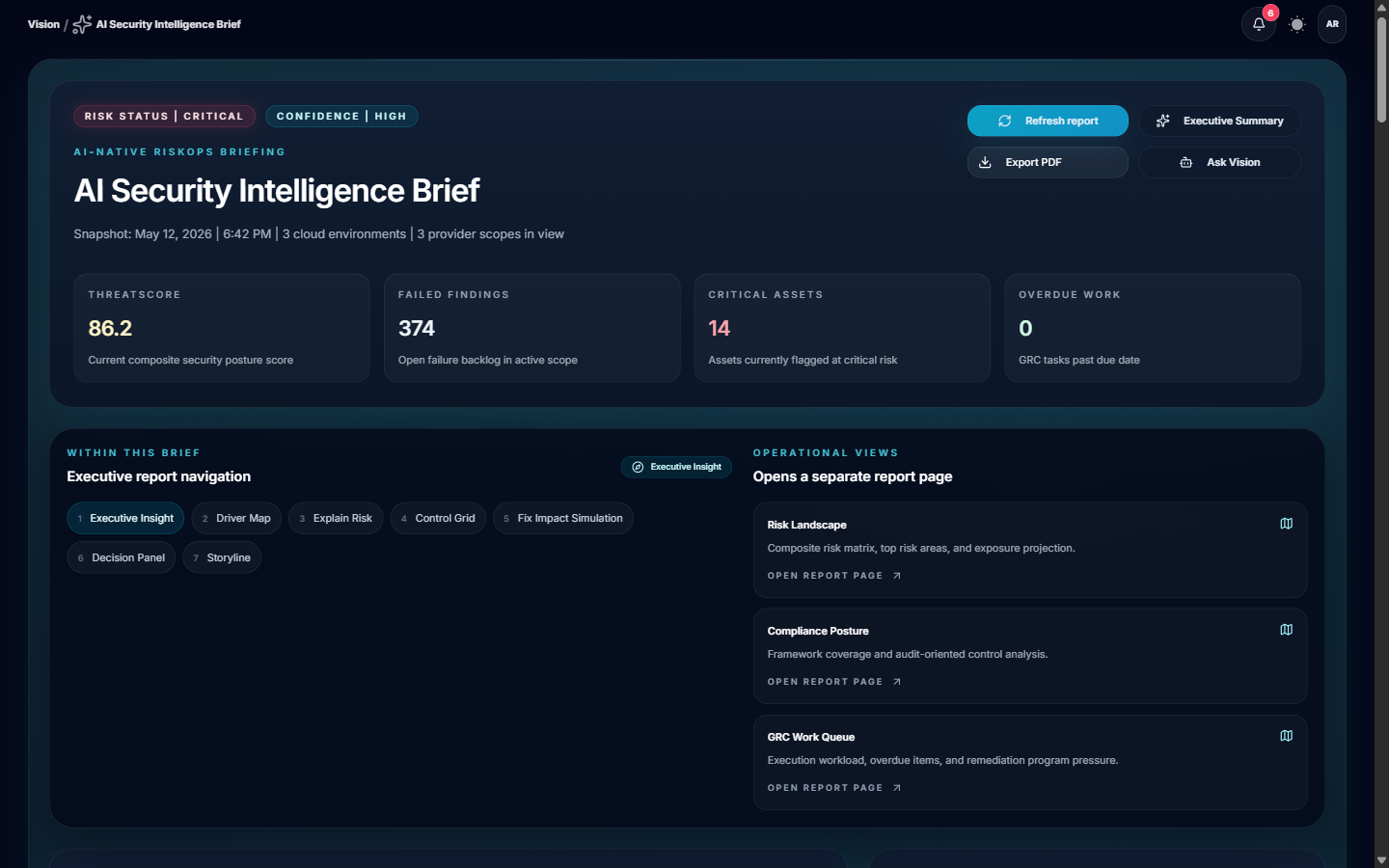
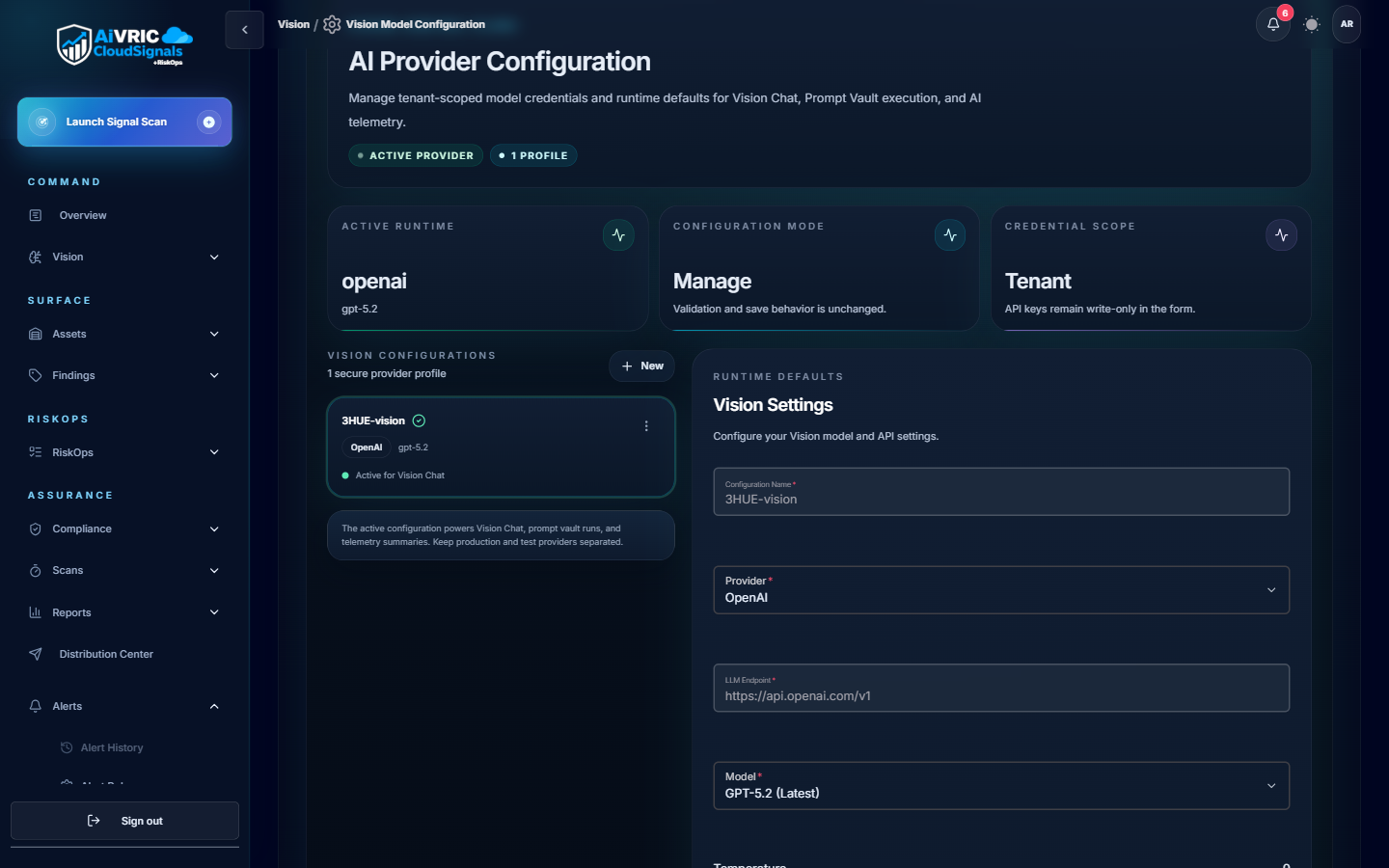
CloudSignals+RiskOps in practice — AiVRIC's Vision module enforces this AI governance policy through continuous monitoring, AI-native intelligence briefing, and configurable model controls. The AI Provider Configuration lets administrators define and govern which AI models are active, at what parameters, and for which users.